Dead Scientists, Part Two: Project Coast, Dr Death and David Kelly
"All Western governments undertake assassinations" he told me. "You're a fool if you don't know that".

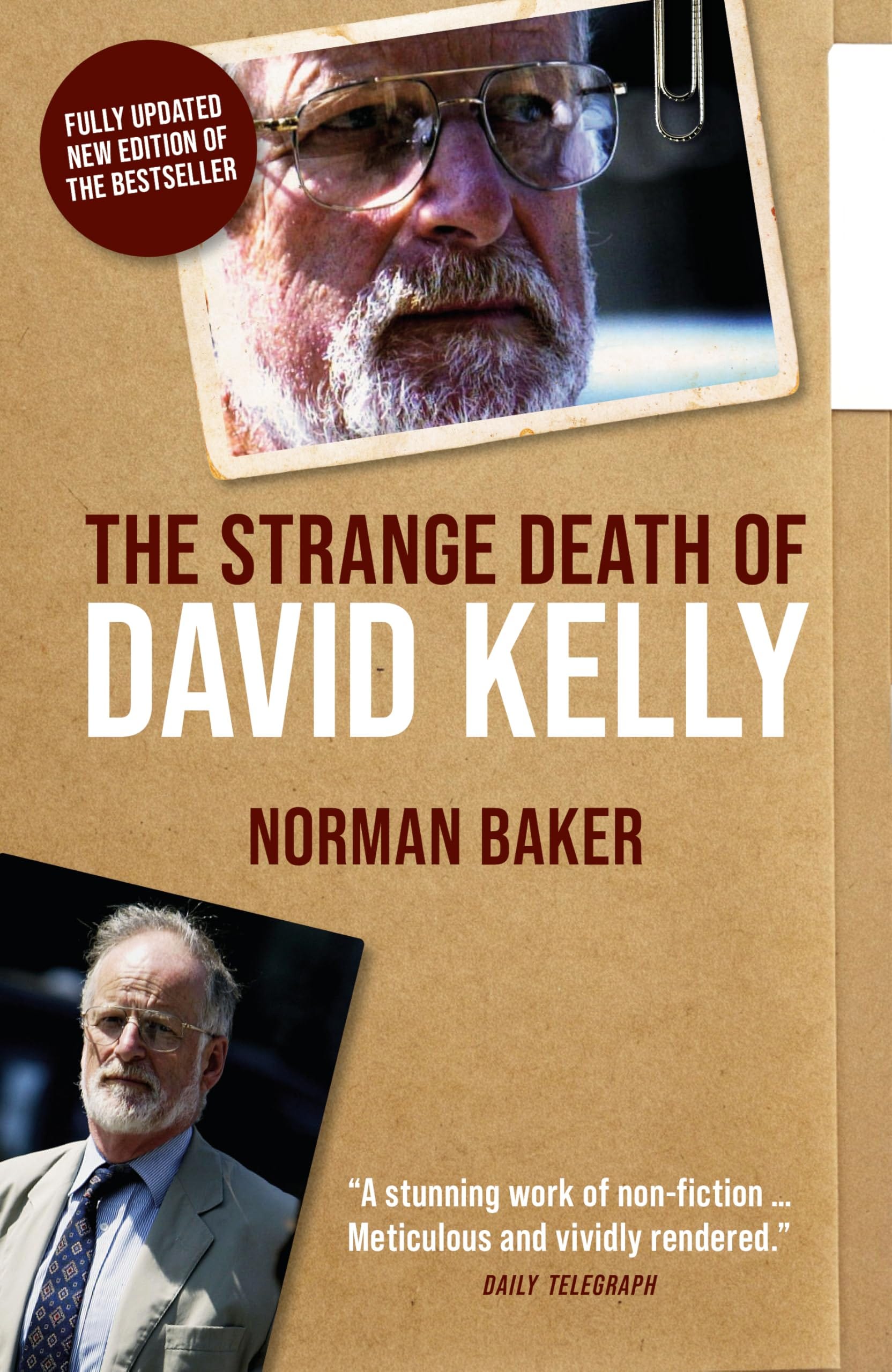
An extract from The Strange Death of David Kelly, by Norman Baker, published 2007 with an updated version released in 2024
There is one further death in the series of ‘dead scientists’ that is worth considering. The investigation of this would lead from an American gynaecologist to the development of chillingly effective biological weapons by the apartheid-era South African government, take in a cottage near Ascot, and link in with David Kelly.
Dr Larry Ford ran a company called Biofem Pharmaceuticals in Irvine, California, with his business partner, James Riley. On 28 February 2000, Mr Riley, having parked his car, was walking towards the front door of Biofem’s building when a masked stranger appeared and shot him in the face. The bullet entered his cheek, gashed his cheekbone and exited just above his lip. He survived.
Fortunately, a witness recorded the number plate of the van in which the assailant had escaped, and it turned out to belong to a Dino D’Saachs, a long-standing friend of Dr Ford. Police discovered from telephone records that Mr D’Saachs and Dr Ford had spoken on the phone that morning. Dr Ford told police the call had been about a prescription.
Mr D’Saachs was subsequently identified as having driven the gunman to the scene, arrested and put on trial for conspiracy to commit murder. He declined to secure himself a lesser sentence by revealing the identity of the gunman and was sentenced to twenty-six years’ imprisonment.
The day after the shooting, police searched Dr Ford’s house and shortly afterwards he was found dead with a gunshot wound to the head. He had left what appeared to be a suicide note, denying any involvement in his business partner’s shooting. Those who knew him found it difficult to believe that he had killed himself. Dr Ford, a Mormon, had himself been subject to an unsuccessful gun attack by an unidentified hitman back in 1978.
The search, inspired by anonymous telephone tip-offs, turned up large numbers of weapons, including over forty hunting rifles and shotguns hidden under floorboards, which even his activity as an avid hunter could not really justify. They also found beneath a concrete slab next to the swimming pool twenty-seven sealed canisters containing military explosives, a massive collection of automatic rifles and other weapons, and several thousand rounds of ammunition. None of the weapons appeared to have been used in the shooting of Mr Riley.
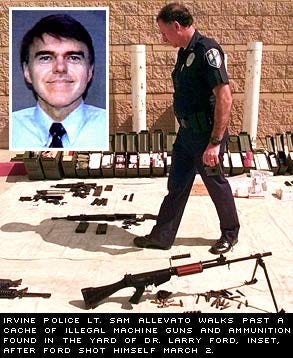
The police, however, were to find material that proved to be even more sinister than the cache of weapons. The telephone tip-offs had suggested that there were canisters of HIV-related material buried somewhere on the property. What they found was a vast array of highly toxic and infectious substances which, had they been released, would have had appalling consequences for huge numbers of people. Twenty-five jars of unidentified substances removed from Dr Ford’s house were found to contain live cultures of cholera and salmonella. Even more alarming, there were also more than 250 bottles and phials of live cultures, holding botulism and typhoid fever, amongst others. A sealed container was found to hold a large quantity of potassium cyanide.
Where had all these weapons, military-grade explosives and biological substances come from?
Dr Ford told his friends that he worked for the CIA. His doctor believed he had done so for about twenty years. The New York Times appeared to back up this suggestion. It reported that police officers deployed to search the property were forewarned that Dr Ford was reported as having worked on developing biological weapons for the CIA, although it was later denied that the police had been so warned. The CIA also denied that he had worked for them, though such denials are standard practice, whether true or not.
There were also reports that Dr Ford, in his role as a gynaecologist, had carried out unauthorised experiments on some of his patients. On one occasion he is said to have infected a student with whom he had been having an affair with an ‘alpha toxin’ that caused neurological damage and led to her having brain surgery.
What is certain, however, is that Dr Ford had strong links with the apartheid government of South Africa, and this provides by far the most likely explanation for his ability to secure highly controlled and dangerous substances. In particular, he was indisputably involved with Project Coast, the highly unpleasant chemical and biological warfare programme run by the Pretoria government from 1981 onwards. The programme was deeply secret, with only a handful of people knowing of its existence. It was answerable to the Defence Minister.
Project Coast was one piece of the jigsaw designed to keep the white supremacist government in power in South Africa. Its aims included the creation of a biological weapon designed to attack the black population while leaving the whites unscathed. The key to this is DNA sequencing, which of course Dr Ford and some of the scientists referred to in the previous chapter were engaged upon. DNA sequencing exploits the idea that substances can be developed that will work to the genetic characteristics of a person, or group of people. Benignly, this holds out the prospect that drugs can increasingly be targeted at specific genes responsible for particular conditions. The likely health benefits are potentially enormous. Less benignly, pathogens can be developed to target individuals based on their racial characteristics, their sex or even their eye colour.
According to the Los Angeles Times, Dr Ford had acted as a consultant to the South African Defence Force, providing advice on matters connected with biological weapons. He was certainly a regular visitor to South Africa, undertaking dozens of trips between 1984 and 2000. Mike Odendaal, a microbiologist who worked at the Roodeplaat Research Laboratories where Project Coast work was undertaken, told the South African Sunday Independent: ‘Ford spent an entire day showing us how to contaminate ordinary items and turn them into biological weapons.’
These ordinary items included pornographic magazines and teabags. From the Truth and Reconciliation Commission hearings in South Africa, we also learnt of chocolates and cigarettes contaminated with anthrax, milk infected with botulism, and salmonella germs in sugar.
The exotic techniques of murder hit the headlines again in the summer of 2007 when, at the end of a trial in South Africa, former police minister Adriaan Vlok and the then police chief, Johan van der Merwe, were found guilty of attempting to kill a black activist, Rev. Frank Chikane, by impregnating his underpants with a nerve toxin. No doubt if anyone had suggested such a scenario prior to Mr Vlok’s arrest, they would have been called a conspiracy theorist by uninformed commentators. Subsequently, of course, there is a suggestion that this technique was used many years later to incapacitate Alexander Navalny.
It also became clear at the Truth and Reconciliation Commission hearings that those involved in Project Coast had spent a great deal of time and effort developing a number of innovative ways to carry out assassinations without leaving a detectable trace. Dr Schalk van Rensburg, the director of the Roodeplaat Research Laboratories, told the commission:
The most frequent instruction we obtained … was to develop something with which you could kill an individual that would make his death resemble a natural death, and that something was to be not detectable in a normal forensic laboratory. That was the chief aim of the Roodeplaat Research Laboratories’ covert side.
One further creation was an organism, Hormoconis resinae, intended to attack aircraft fuel, clog fuel lines and cause engines to splutter and fail. It is unlikely that even the thorough investigations carried out by the Air Accidents Investigation Branch of the Department for Transport ever considered that this might be the cause of a crash.
Dr Ford was close friends with General Niels Knobel, the surgeon general of the South African Defence Force, who theoretically had overall operational responsibility for Project Coast. In practice, General Knobel was happy to provide large sums of money without very much explanation to the man who really drove Project Coast forward, Dr Wouter Basson, described by South African papers variously as ‘the South African Mengele’ and ‘Dr Death’. It was General Knobel who introduced Dr Ford to Dr Basson in the mid-1980s. And it was Dr Basson, and a Dr Swanepoel, who issued the instructions to Dr van Rensburg referred to above.
The end of the apartheid era and the formation of a government under Nelson Mandela eventually led to Project Coast being officially closed. However in his book Elimination Theory, the American T. J. Byron, who had worked as an ‘informant agent’ for both the CIA and South African intelligence at the time of Project Coast, claims that the programme was not really shut down at all, and in particular that the huge store of chemical and biological agents was simply moved to other sites in South Africa, and also to sites abroad. He also alleges that Project Coast was supported at arm’s length by successive US administrations, even to the extent that they turned a blind eye to the free movement of deadly bacterial strains and pathogens between the two countries. If true, it is likely that the UK under Mrs Thatcher would have had a similar policy.
It must be more than possible, therefore, that the haul of toxins found in Dr Ford’s house was part of the material that had originally been held in South Africa. Certainly much of the material was quite old, according to the FBI, which would be consistent with material produced prior to the official closure of Project Coast in 1993. We also know that Dr Ford was not averse to carrying such material across the world himself. His laboratory assistant Valerie Kesler said that she had once travelled with him to South Africa when he had a phial in his jacket pocket. He handed it to a South African official upon arrival.
According to the writer Gordon Thomas, the Israeli secret service, Mossad, believes that Dr Ford had links with Dr Kelly. In an article for the Sunday Express, Mr Thomas pointed out that three of the cultures in particular found at Dr Ford’s house — cholera, botulism and typhoid fever — were ones Dr Kelly had been working on at Porton Down.
Dr Kelly had certainly met Dr Basson. It appears he visited Porton Down at least once. It also seems that Dr Kelly, with official sanction, visited Delta-G, South Africa’s equivalent of Porton Down, around the time of the fall of the apartheid regime. Dr Basson was a frequent visitor to Britain, and for years used a cottage in Watersplash Lane, in the village of Warfield, near Ascot. It is clear that this was not a holiday home.
In 2001, a glimpse into the world of Dr Basson was provided when a former secretary of his dramatically revealed what her job had entailed. If Patricia Leeson had expected that she would just be typing or filing, she was to get a rude awakening. Rather than taking a letter, she found herself taking £50,000 in cash to Heathrow airport to hand over to a man called ‘Roger’. In true spy style, she had to wear a bright red dress with a distinctive brooch to aid recognition. She was to answer to the name Vanessa. Her ten months’ employment, in 1987, was filled with codenames, false passports, bundles of cash and circuitous routes to shake off anyone who might be following her.
On one occasion, she was asked to leave her house in Ascot for the day to enable a secret meeting to take place. She returned to find Jan Lourens, a colleague of Dr Basson’s, looking extremely pale. He explained that he had nearly killed himself with a poisoned umbrella. Mr Lourens would go on to tell the Truth and Reconciliation Commission that on one occasion, he delivered two phials containing toxins and a screwdriver containing a biological poison to Watersplash Lane.
Dr Basson’s cottage was one of a pair of semi-detached three-bedroom properties, originally built to house farm workers. The pair sit some considerable distance from the next nearest property. Dr Basson’s neighbour, John Stockton, still resided there when I made contact. He told me that Dr Basson was ‘a very nice person’. They had been good neighbours and Mr Stockton had regularly been in Dr Basson’s house. There had also been a steady stream of South African visitors and the occasional American. He found it difficult to believe that the house might have been used for any illegal activity.
After the fall of the apartheid regime, Dr Basson established contacts with Libya, a development that concerned both the United States and the UK. He was in fact interviewed by a team from both countries. It is likely Dr Kelly would have been part of this process.
In August 2007, I tracked Dr Basson down to the hospital in the Western Cape where he was working as a cardiologist, saving lives. He was both friendly and helpful, almost disarmingly so. I could understand why his neighbour had reached the view he had.
Dr Basson told me that he had first met Dr Kelly in 1985 at Porton Down and the two continued to meet occasionally until the late 1990s, and to speak on the phone thereafter, including to discuss the Iraqi capability in weapons of mass destruction. Dr Basson was in no doubt that there was nothing to be found in the country and told me that he went on South African television two weeks before the invasion to say so. Pertinently, he formed the view that Dr Kelly doubted that there was much to be found in terms of weapons of mass destruction, but he thought that he may have internally suppressed those doubts.
I asked him if he thought Dr Kelly had been murdered. He paused, as if choosing his words carefully, then replied that he did not know for sure, but Dr Kelly ‘didn’t seem the sort to commit suicide’. He was in no doubt, however, that the UK, and indeed other Western countries, have a capacity for assassination. He seemed to know what he was talking about.
‘All Western governments undertake assassinations,’ he told me. ‘You’re a fool if you don’t know that.’
It is clear that there was substantial contact between the white government in South Africa and both Britain and the United States in respect of chemical and biological weapons. There is no doubt that Dr Kelly’s contacts, and those of his colleagues at Porton Down, were officially sanctioned. The official position was set out in a parliamentary answer in June 2006:
The then Conservative Government were aware of the existence of legitimate South African chemical and biological defence programmes from the 1980s. Initial reports indicating offensive chemical and biological weapons activities, later known as Project Coast, were not received until 1993, but they were inconclusive. There were also unsubstantiated claims of chemical weapon use by South African forces in Angola, Mozambique and Zimbabwe in the 1980s and 1990s. More detailed evidence of previous offensive activities was received in the years leading up to the truth and reconciliation hearings in 1998, when further details of the offensive activities emerged. In 1994, we understood that the South African government had terminated offensive chemical and biological weapons activities.
The government also stated, in response to another parliamentary question, that it had ‘no reason to doubt’ that the stores of biological materials assembled by Project Coast had been destroyed, and, in response to a third parliamentary question, that there was ‘no record’ of collaboration between Ministry of Defence officials and the Roodeplaat Research Laboratory, which is of course not the same as denying that such contact existed. It did concede that UK officials had attended a meeting with the South African surgeon general and Dr Basson in 1995, which, according to T. J. Byron, was the year the United States pressurised the Mandela government to re-employ Dr Basson, so that he could be brought under military control again, following his dealings with Libya.
Interestingly, the official answer from the armed forces minister, Adam Ingram, ended with the following sentence: ‘I am not in a position to comment on the activities of Her Majesty’s Government-funded institutions outside the Ministry of Defence.’ In other words, he could not speak for Porton Down.
It is no secret that the Thatcher government was sympathetic to the white administration in Pretoria and openly opposed sanctions on the regime. Its continued dealings with Pretoria may therefore have reflected this, or a belief that it was necessary to sustain the white government to ward off communism or anarchy in South Africa. That was certainly the view of the United States. Alternatively, the decision to keep channels open may have been based on the pragmatic view that a degree of contact would at least allow a continual assessment of South Africa’s capabilities in this most sensitive field to be undertaken. Whatever the reason, it is likely that Dr Kelly would have known much of what South Africa had been up to, and also the complicit nature of the response at the time from Washington and London.
Dr Basson told me that from 1985 until the late 1990s, he was allowed to move around the UK unhindered, provided he did not ‘push anyone under a train’. He seems to have been regarded as a useful asset, and told me of regular meetings with those he termed ‘your secret intelligence guys’, who were particularly interested in what he could tell them about Iran.
Then in 1998, while he was in Pretoria, he received a minimalist letter from the British Home Secretary, Jack Straw, which told him that he was no longer welcome in Britain. No specific reasons were given. A similar ban was put in place by the United States. The ban has been rigorously enforced — he has not been allowed even to use Heathrow airport for transit purposes. He says that he sold his cottage in Watersplash Lane at around the same time as the ban came in.
In his book Gideon’s Spies, Gordon Thomas asserts that the week before Dr Kelly died, the weapons inspector had been told that he was to be questioned by MI5 about his involvement in bringing Dr Basson to Porton Down. If true, it is probable that this development would have come about as a by-product of the heightened interest in Dr Kelly amongst British intelligence, which may have uncovered the historic link between the two men. In terms of a motive for the murder of Dr Kelly, it is possible therefore to speculate that somebody did not want this interview to take place for fear of what Dr Kelly might say. Dr Basson told me this suggestion was ‘rubbish’, and added: ‘The only person who knows about Project Coast is me, and I’m not talking.’
But what could Dr Kelly say? Certainly any revelations about co-operation between the apartheid regime of South Africa and the British government might have been embarrassing for the latter. They might have shown that the British were not only breaking the established sanctions regime but actually aiding the South Africans to develop an offensive chemical and biological weapons capability, and one designed, in the most heinous way, to target the majority black population.
On the other hand, the events in question all occurred some ten years earlier, and under a government of a different party. Moreover, there seemed to have been attempts in the 1990s to help close Project Coast down, so it should not have been politically impossible to smudge the whole thing over.
Could those who were involved from the South African side have feared what Dr Kelly might say? It seems unlikely. The Truth and Reconciliation hearings allowed the truth to emerge in a way that enabled the majority of those involved to put the matter behind them. As far as Dr Basson himself was concerned, he had been arrested in 1999 in South Africa and put on trial, but he had been found ‘not guilty’ of all charges brought against him, and was continuing to receive an income from the South African authorities.
Moreover, if anyone with experience of Project Coast had been involved in his death, they would doubtless have managed to make a more professional and convincing job of it, particularly given the experience they had chillingly built up. After all, the main focus of the Roodeplaat Research Laboratories had been to develop assassination techniques which left no trace.
The whole truth about Project Coast and the links with Britain in general and Dr Kelly in particular has yet to come out, but on the basis of what we know, it seems unlikely that this was a telling factor in the death of Britain’s leading weapons inspector.
Very interesting, Mr Baker. Thank you. Achieving the right balance in government between secrecy and transparency/accountability is not easy; but secrecy is too often the chosen option. Secrecy and its methods too often allow those with nefarious motives and intent to get away with their crimes.